





6.5 min
of real-world walking data
Contact-UAN uses proprioception to align contact forces before learning an actuator residual, making residual world modeling work for floating-base humanoids and improving force/impulse-sensitive hardware behaviors from 6.5 minutes of walking data.
6.5 min
of real-world walking data
43%
lower force-tracking error
20%
more torque efficiency
Humanoid policies trained in simulation can transfer qualitatively to hardware while failing to transfer the force interactions learned during training, compromising torque efficiency, load regulation, and robustness to impacts. This failure can arise from actuator sim-to-real gaps because forces depend on actuator torques. We introduce Contact-UAN, a residual world model that preserves a simulator's physics priors while correcting the actuator command channel to align simulated rollouts with recorded hardware rollouts. For humanoid motion with contact, this requires contact-consistent replay: if hardware playback in simulation begins with misaligned contact wrenches, the residual model learns to correct reset artifacts rather than actuator discrepancies. Using only onboard proprioception, Contact-UAN infers the simulator-side stance-foot pose needed to initialize replay with consistent contact forces. We show that a UAN trained on 6.5 minutes of real-world walking data generalizes to tasks that benefit from accurate force and impulse regulation and produces policies that transfer seamlessly to the real world, yielding 20% lower running torque, 43% lower force-tracking error, extreme compliance, accurate impedance control, and dynamic, robust jumps.
The problem
Humanoid policies can reproduce qualitative motion on hardware while failing to reproduce the force interactions learned in simulation. Policy optimization can exploit imperfect actuator dynamics, leading to excessive torques, poor commanded-force tracking, or failures during high impulse phases.
The actuator fidelity required for transfer is task-dependent: simple models may be sufficient for quasi-static behavior, while efficient running, force tracking, jumping, and landing depend on accurate actuator response, force generation, and impact absorption. Contact-UAN learns that missing actuator correction from onboard proprioception alone.
How can we close the sim-to-real gap with contacts for humanoid control without torque sensors, contact force sensors, or motion capture?
The method
Infer base velocity and simulator-side stance-foot pose from onboard proprioception.
Train the UAN to correct recorded commands so that simulated transitions better match hardware.
Freeze the UAN during downstream training; run only the learned task policy on the robot.

The Unsupervised Actuator Network (UAN) adds a residual correction δqt to the base joint-position target:
qtcmd = qtbase + δqt.
This preserves the simulator's rigid-body dynamics, actuator implementation, contact solver, and numerical integration while correcting only the actuator command channel. During downstream policy training the UAN is deterministic and frozen, forcing high-reward behaviors to remain feasible under the corrected actuator response.
Contact-consistent replay
Open-loop replay isolates actuator-model error only when simulation starts from a hardware-equivalent state. In a soft-contact simulator, that state is not necessarily the robot's literal absolute height: it is the simulator-side stance-foot pose whose small penetration and tilt reproduce the support wrench implied by the hardware trajectory.
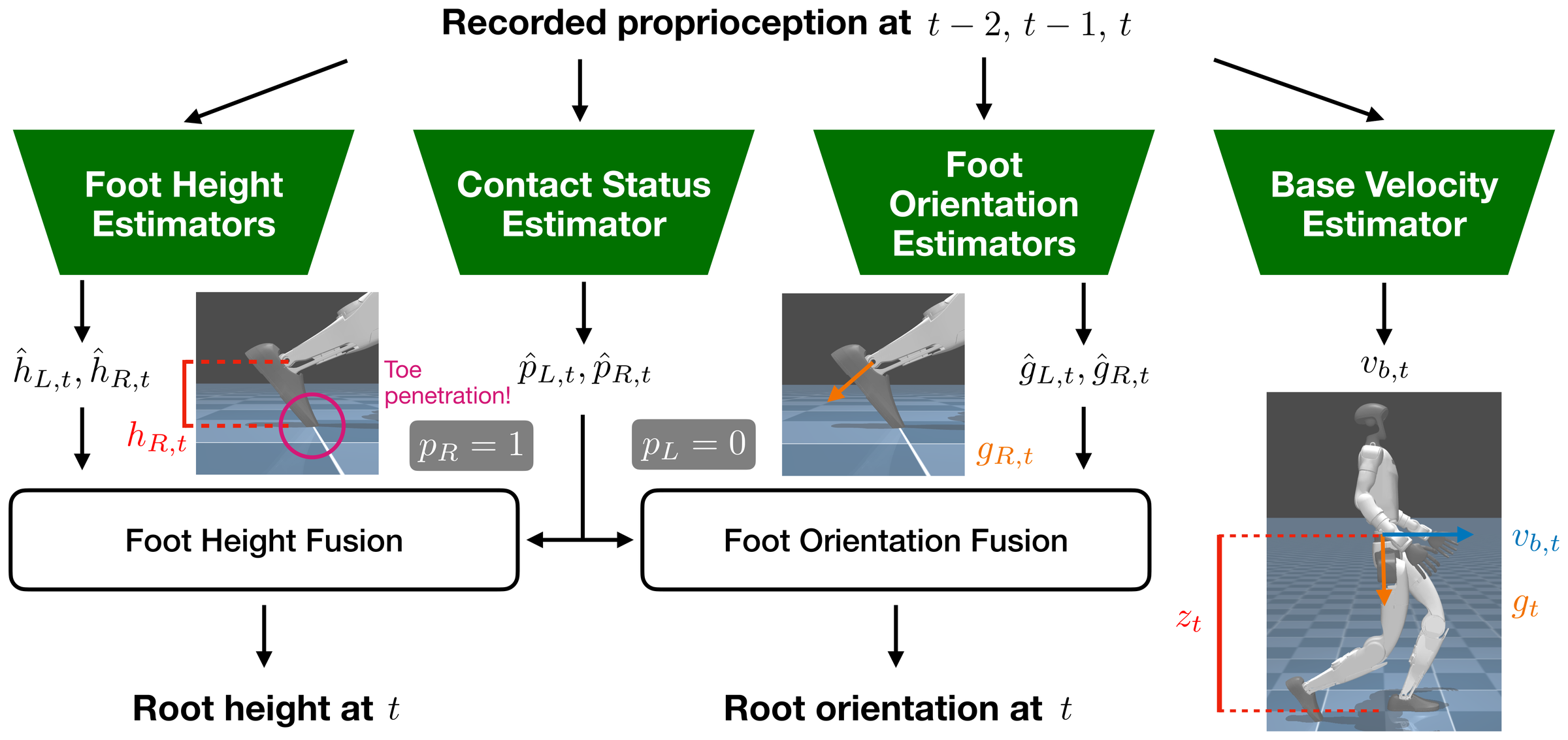
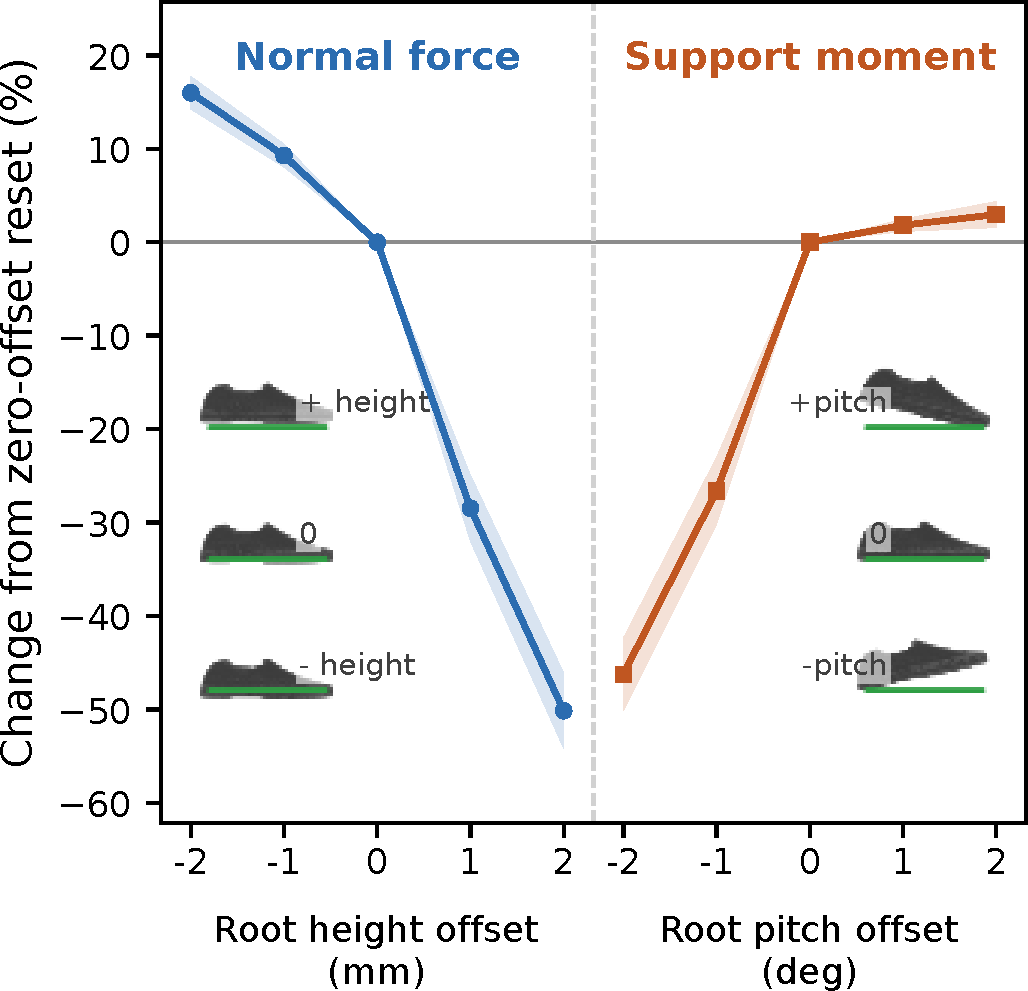
Contact pose is estimated in two stages: classify contact status, then regress the penetrating foot pose only for feet confidently in stance. Candidate root poses are fused using contact-probability weights. Restricting regression to stance reduces contact-height RMSE by an order of magnitude over direct regression across all gait phases. This precision is essential: in the paper's MuJoCo model, a +2 mm root-height offset reduces normal force by roughly 50%, while a −2° pitch offset changes the support moment by roughly 45%. The estimator omits absolute base height, preventing it from copying a height that may not transfer to hardware.
Model validation
Contact-consistent relabeling removes reset artifacts from hardware replay. The UAN then closes the remaining actuator mismatch, reducing 24-step joint-position error and closely matching held-out running trajectories.
Real-world transfer
A single UAN trained once on walking data supports running, whole-body force control, extreme compliance, proprioceptive impedance control, and dynamic jumping on a 29-DoF Unitree G1. Downstream policies are trained in the frozen UAN-augmented simulator with no robot-specific domain randomization; terrain, ground friction, and pushes are still randomized to encourage robust recovery.
Controlled ablations
In a controlled sim-to-sim transfer experiment, fully learned offline world models struggle even with 33 hours of transitions—approximately 400× more data than the 5-minute UAN dataset.
Adding task-specific running data provides little additional benefit over walking data, indicating that the actuator residual generalizes beyond the behavior used to collect it.
Current scope
Contact-UAN models each actuator independently and does not capture inter-joint actuator coupling or motor-temperature-dependent effects. Coupling could be modeled with a whole-body network or cross-attention; temperature effects may require longer datasets, heat modeling, or additional sensing.
Questions & answers
A world model predicts the next state from the current state and action. Contact-UAN keeps the simulator's rigid-body dynamics and contact physics, then learns only the actuator-command correction needed for simulated joint transitions to match hardware. It is residual because it corrects an existing physics model instead of replacing it.
Fully learned models such as RWM-U must represent the complete robot-environment transition. Contact-UAN retains the simulator as a strong structural prior and learns only the actuator gap. In the controlled sim-to-sim experiment, a UAN trained with 5 minutes of target data reaches expert-level survival, while fully learned offline models struggle with 33 hours of transitions.
System identification is limited by the chosen parameterization, while broad domain randomization can produce conservative policies that under-use the hardware. Contact-UAN learns a reusable actuator correction directly from proprioceptive trajectories and removes robot-specific randomization from downstream policy training.
In a soft-contact simulator, millimeter-scale foot-height and degree-scale orientation errors can substantially change the contact wrench. Without a contact-consistent reset, the UAN may learn to correct an initialization artifact instead of the actuator gap. The proprioceptive estimators infer the simulator-side stance-foot pose that produces the appropriate support interaction.
No. The UAN is trained once on walking data and then frozen. Running, force-control, impedance, and jumping policies are trained independently in the same UAN-augmented simulator.
Only the downstream task policy. The state estimators are used for offline relabeling, and the UAN is used only while training policies in simulation.